Practical guides and training content on cybersecurity and growth for startups. Our content is continuously expanded based on the needs of our customers and community.
The most common questions and practical instructions regarding cybersecurity for companies.

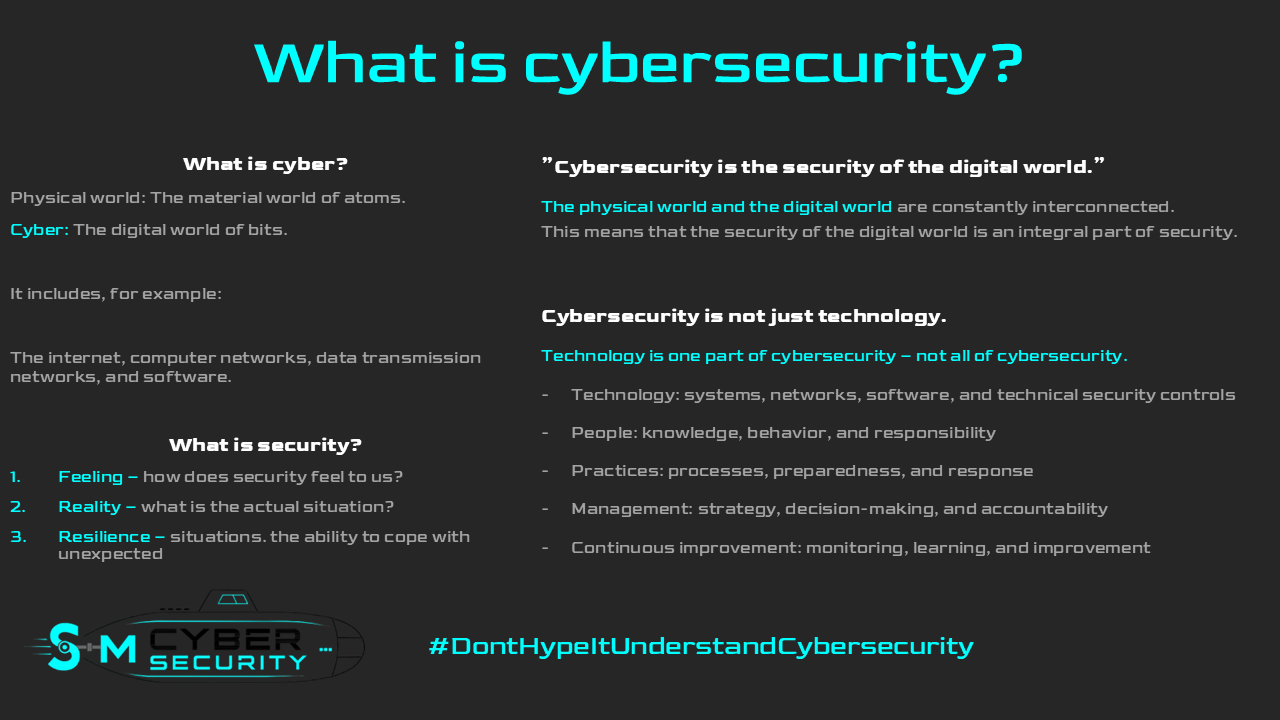
Cybersecurity is the protection of a company's operations, data, systems, and people from cyber threats, as well as maintaining the ability to operate safely even during disruptions and incidents.
Cybersecurity is not just about protecting technical systems. It is a comprehensive approach that identifies risks to the company's operations, prioritizes the most important measures, builds defenses, and continuously develops operations based on changing threats.
The goal of cybersecurity is to protect the information, systems, services, users, and technical environment that are important to the company's business. Things to protect can include, for example, customer and personal data, email, user accounts, web services, applications, cloud services, the network environment, and business-critical systems.
In cybersecurity, it is also important to understand how the disruption or compromise of these would affect the company's operations.
A cybersecurity risk can directly affect business continuity, finances, customers, personnel, and the company's reputation. Therefore, security should not be viewed as an isolated technical entity, but as part of the company's risk management and decision-making.
A risk-based approach helps focus time, money, and expertise on the risks that matter most to the company.
The first step is to form a clear picture of the current situation: what the company has to protect, what threats it faces, where the vulnerabilities or gaps are, and how significant their impact could be.
After this, the most important risks are prioritized, and based on them, corrective measures, security solutions, and development goals are defined. However, cybersecurity is not built once and for all; it is continuously monitored, evaluated, tested, and developed.
Good cybersecurity helps a company understand its risks, protect what is important to its business, and maintain operational capability even in a changing threat landscape.
The most common cybersecurity risks relate to things like user accounts, malware, phishing, vulnerabilities, inadequate security settings, and data misuse.
A company's cyber risks often arise from a combination of several factors. In addition to technical flaws, risks can be caused by factors such as user behavior, outdated systems, inadequate access management, or unclear operating procedures.
Compromised user accounts are one of the most significant cyber risks for companies. Weak passwords, missing multi-factor authentication, overly broad access rights, and phishing can enable unauthorized access to company data and systems.
Therefore, user identification, authentication, access rights, and access management are key areas that need to be protected.
Vulnerabilities in software, systems, networks, applications, and cloud services can give an attacker the opportunity to gain access to systems or data. Misconfigurations, outdated software, and inadequate security settings can also increase risk.
Identifying, prioritizing, and fixing vulnerabilities is therefore an essential part of developing cybersecurity.
Companies can be targets of phishing, malware, ransomware, and other attacks. As a result of an attack, data can be stolen, altered, destroyed, or published without authorization.
Risks are mitigated by combining technical protections, secure staff practices, continuous monitoring, preparedness, and effective recovery procedures.
A company does not need to try to eliminate all cyber risks. The goal is to identify the most significant risks, assess their impact and likelihood, and focus the most important protection and development measures on the right targets.
Developing a company's cybersecurity begins with knowing what needs to be protected, what threats are associated with the environment, and where the greatest risks lie.
Not all risks can be eliminated, nor do all risks need to be handled in the same way. It is essential to form a comprehensive view of the company's operations, identify significant risks, and prioritize them based on their impact and likelihood.
Start by identifying the company's most important data, systems, services, users, and technical environments. Also, consider dependencies, such as cloud services, external vendors, and business-critical systems.
Consider, for example, threats to user accounts, malware, phishing, system vulnerabilities, misconfigurations, data breaches, and other potential attack vectors. Identifying risks can involve both technical assessments and a review of organizational practices.
Prioritize risks based on their likelihood, impact, and significance to the business. Corrective measures and protections should be applied to the highest-priority risks first. Prioritization also helps allocate limited resources effectively.
A good risk profile is not a single checklist, but an up-to-date overview of a company's cybersecurity. When the most important risks are identified and prioritized, a goal-oriented and measurable development plan can be built based on them.
Practical guides and training for startup growth, sales, customer acquisition, and business development.

Defining the right target customer is one of the most important starting points for startup growth. This guide walks through how a company can identify the customers for whom its solution provides the most value.
It is difficult to build growth if a company tries to sell to everyone. Identifying the right target customer helps align the product, messaging, sales, and marketing with those customers who have the greatest need and the best potential to buy.
Start by defining what kind of customer benefits most from your solution. Consider, for example, the customer's problem, industry, company size, current way of working, purchasing need, and how significant an impact your solution has on the customer's business.
The Ideal Customer Profile, or ICP, describes the customer profile that best fits a company. An ICP helps narrow down the target market and focus sales and marketing efforts on companies where the probability of purchase and customer value are highest.
A good target customer is not just any company that could use the product. It is essential to understand what problem the customer has, how significant that problem is, and what it costs the customer to leave it unsolved.
An ideal target customer helps a startup focus its limited resources correctly. The better a company understands who it creates value for and why, the easier it is to build a functional value proposition, sales process, and growth model.
An Ideal Customer Profile, or ICP, helps a startup define which types of customers are the best fit for their product or service and which customer segments hold the greatest growth potential.
With an ICP, a startup can move from a general target market to a more precise customer profile. The goal is to identify those customers for whom the solution provides the most value, who have a genuine need, and with whom the company has the best conditions to build a long-term relationship.
An ideal customer doesn't just mean a company that can buy the product. It is worth considering factors such as the significance of the customer's problem, their need to buy, available resources, decision-making processes, and the potential value the solution can provide.
An ICP can be defined based on factors such as industry, company size, location, technology, business model, current challenges, buying behavior, and other characteristics significant to the company. The key is to choose factors that help predict customer value and the likelihood of purchase.
An ICP can be utilized in sales targeting, marketing, customer acquisition, communications, and prioritizing the sales process. It also helps identify which customers are not the company's primary target groups.
A well-defined ICP helps a startup focus its limited resources on the right customers. It serves as the foundation for targeted sales and marketing and helps build more repeatable growth.
A clear value proposition tells the customer who the solution is for, what problem it solves, and what concrete benefits the customer can achieve.
A good value proposition doesn't focus primarily on what the company sells, but on what the customer gains. The purpose of a value proposition is to make the company's offering quickly understandable, relevant, and a perfect fit for the customer's needs.
Start with the customer's real problem. What challenge are they trying to solve, what isn't working in their current approach, and why is this problem significant to them right now? The more precisely the problem is understood, the easier it is to build a relevant value proposition.
Define how the customer's situation changes with the solution. Value can relate to, for example, saving time, reducing costs, mitigating risk, increasing sales, improving efficiency, or achieving a new opportunity.
A value proposition must also distinguish the company from the alternatives. Consider what makes your solution better, faster, easier, safer, or otherwise more significant for the customer than their current way of working or a competitor's solution.
A functional value proposition connects the customer's problem, the value to be achieved, and the company's own differentiation. When these three elements are clear, they are easier to leverage in sales, marketing, on the website, and in building the company's overall growth.